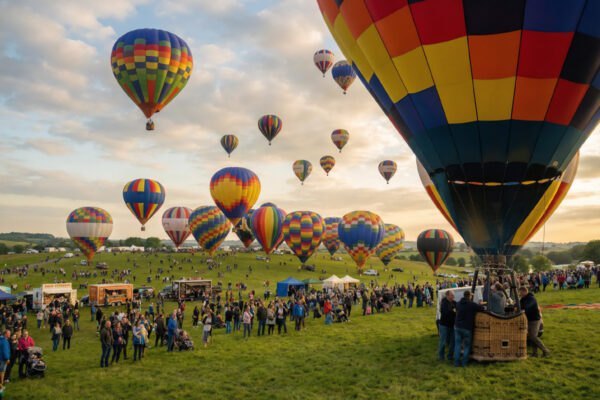
Organizing a balloon flight at a festival or cultural event is an undertaking that requires very careful preparation. A balloon is not an ordinary outdoor attraction. Every ascent takes place in airspace, which imposes specific legal, logistical, and safety obligations on the organizers.
Audiences at festivals are eager to take advantage of the opportunity to see the area from a bird’s-eye view. The growing popularity of this form of entertainment means that more and more municipalities and cultural associations are including balloon flights at events in their programs. However, before a balloon takes to the air, dozens of details must be taken care of, from choosing the right location and notifying aviation authorities to having an action plan in case of changing weather.
The entire process of organizing a flight can take anywhere from a few days to several weeks. Every stage is important. Skipping any of them could result in a denial of flight permission or, in the worst case, a risk to the safety of the participants.
What organizing a balloon flight at a festival involves step by step
Proper organization of a balloon flight begins long before the day of the event. It is crucial to plan the entire process in a logical order without skipping any steps. The organizer must remember that a balloon is an aircraft, and its operation is subject to aviation regulations, not just the standard rules for organizing outdoor events.
Initial actions include assessing the terrain, contacting an experienced ballooning company, and establishing the event’s timeframe. In parallel, official formalities are handled, which are discussed later in the article. Only after obtaining the necessary permits can one proceed to the detailed schedule for the day of the event.
Choosing the launch and landing site for a balloon at an event
Choosing the right launch site is one of the most important decisions when planning a flight. The area must be large enough to accommodate the balloon during inflation, and the surroundings must not pose a threat to the aircraft. Obstacles such as trees, power lines, or buildings must be at a safe distance.
The balloon landing site is more difficult to plan than the launch site because it depends largely on the wind direction on the day of the flight. In the case of tethered flights, the landing takes place at the same location as the launch, which significantly simplifies planning. For free flights, only an approximate direction and landing area are designated, and the ground crew follows the balloon.
The minimum launch area for a balloon with a capacity of 2,000 to 4,000 cubic meters is usually about 60 by 60 meters. A special safety zone must be cordoned off on the festival grounds so that the public does not approach the balloon during inflation and launch.
Flight schedule and managing the participant queue
Efficiently managing the participant queue is one of the practical challenges of any event featuring a balloon flight. One flight lasts from a few to several dozen minutes, and a balloon can carry a limited number of people at a time. Therefore, the schedule must be realistic and account for the time required for balloon inflation, boarding, the flight itself, and disembarking.
The balloon flight schedule is best prepared by dividing it into time slots. For tethered flights, one cycle usually lasts from 10 to 20 minutes and includes boarding the basket, ascending to a height of up to 30 meters, a short stay in the air, and returning. In good weather conditions, a dozen or so such cycles can be carried out within a few hours.
Queue management rules:
- Sale or reservation of tickets assigned to a specific time slot
- Designating a meeting point for participants outside the launch zone
- Informing those waiting about the current status of flights and any potential delays
- Designating a person responsible solely for assisting participants at the basket
Good communication with participants is the key to a smooth event. Delays happen often, especially with changing weather conditions. People with tickets must know what is happening and when they can expect their turn.
Ground crew coordination during a festival
Without an efficient ground crew, no balloon flight is possible. During a mass event, the role of this group is particularly important because the area is crowded, and the risk of an unauthorized person accidentally entering the launch zone is significantly higher than during a normal flight.
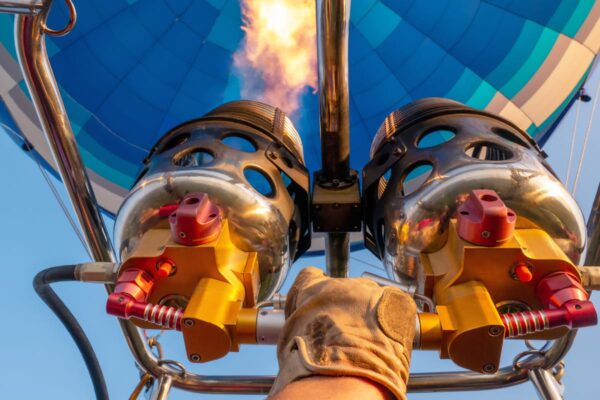
The balloon ground crew usually consists of four to six people. Each of them performs a specific function: from operating the burner and baskets, to holding the mooring lines, to controlling access to the safety zone. The pilot directs the entire operation, but without an efficiently functioning ground team, the flight cannot take place.
Ground crew composition during an event:
- A pilot with a valid license and experience in public flights
- A navigator or pilot’s assistant responsible for the burner and altitude control
- Two to four people holding the mooring lines during a tethered flight
- A person responsible for the safety of the zone and contact with participants
The event coordinator on the side of the cultural organizer should remain in contact with the pilot at all times. Information about the artistic program schedule, the expected crowd, or changes in access to the area has a direct impact on flight safety.
What formalities and permits are required for a balloon flight at an event
Before a balloon flight at a public event can take place, the organizer must go through a series of formalities. Aviation regulations in Poland treat a balloon as an aircraft, which means the full application of Civil Aviation Authority regulations. The lack of required documents can result in a flight ban or a fine.
The scope of required documents depends on the type of flight. Tethered flights are subject to slightly more lenient regulations than free flights. However, even in the case of a tethered balloon, the company performing the flight must have the appropriate certificates, and the flight itself requires notification to the relevant aviation institutions.
AOC Certificate and balloon pilot license for a public event
AOC Certificate (Air Operator Certificate) is a document confirming that a balloon company meets the safety requirements for conducting commercial flights with passengers. It is issued by the Civil Aviation Authority after verification of operational procedures, the technical condition of the equipment, and personnel qualifications. Without this certificate, a company cannot legally charge fees for public flights.
A balloon pilot must hold a valid license issued by the Civil Aviation Authority or an appropriate foreign authority recognized in Poland. The balloon pilot license contains ratings specifying the types of balloons the pilot is authorized to fly and the maximum basket capacity. A valid aviation medical certificate is also required.
The organizer of a festival or cultural event does not need to hold an AOC certificate themselves. They can commission the organization of the flight to a specialized balloon company that possesses all the required documents. However, before signing a contract, it is worth requesting a copy of the certificate and checking its validity in the Civil Aviation Authority registry.
Flight notification to the Civil Aviation Authority
Every balloon flight in Polish airspace requires prior notification to the Polish Air Navigation Services Agency. The notification must be submitted at least 10 days before the planned flight. Near airports and in special controlled zones (CTR, MCTR, ATZ, or MATZ), this requirement is mandatory for all balloon operators.
The notification must contain several key pieces of information necessary to assess the impact of the flight on air traffic:
- Details of the organizer and the balloon operator
- The exact geographic location of the launch site in degrees, minutes, and seconds
- The planned date and time of the flight and the estimated duration
- Balloon characteristics: dimensions, colors, and maximum flight altitude
The Polish Air Navigation Services Agency may provide three types of responses: full approval, refusal due to air traffic safety risks, or conditional approval. Conditional approval, the most common form of response, requires the organizer to contact the air traffic controller 15 minutes before takeoff.
Insurance and civil liability of the organizer
Civil liability insurance for a balloon operator is a formal requirement without which a company cannot legally perform flights with passengers. The policy must cover damages caused to passengers, third parties on the ground, and property. Minimum insurance amounts are defined by EU regulations regarding civil aviation.
An event organizer who commissions a flight to an external company should ensure that an appropriate contract is signed, specifying the division of responsibility. The balloon company is responsible for flight safety and the technical condition of the equipment. The event organizer is responsible for order in the launch zone, access to the area, and properly informing participants about safety rules.
When entering into an agreement with a balloon operator, it is worth checking whether the liability insurance policy covers the specific conditions of a mass event. Standard aviation insurance may not cover all risks associated with organizing a flight in the crowded environment of a festival.
How weather conditions affect balloon flights during a festival
Weather is the most important factor that determines whether a balloon flight during a festival will take place. No pilot will take off in unfavorable atmospheric conditions, even if a dozen people are waiting for the flight. Safety rules in balloon aviation are indisputable.
Permissible wind speeds and visibility at takeoff
Wind speed is the primary parameter evaluated before every flight. For tethered flights, the wind cannot exceed 2 meters per second, which corresponds to about 7 kilometers per hour. For free flights, the maximum permissible wind speed is usually 15 kilometers per hour, although the exact value depends on the operational procedures of the given balloon operator and terrain conditions.
Horizontal visibility must be at least several kilometers. Flying in conditions of fog, low cloud base, or precipitation is strictly prohibited. Before takeoff, the pilot evaluates all these parameters based on the current weather report and their own observation of the terrain and the sky.
Procedure for canceling or postponing a flight due to weather
Canceling a flight is the pilot’s decision, not the event organizer’s. Even if all tickets have already been sold and the audience is waiting at the launch site, the pilot has the full right and duty to refuse the flight in the event of strong winds, storms, or poor visibility. The safety of participants takes precedence over the event schedule.
Good organizational practice involves developing a contingency plan in case of a weather-related flight cancellation. You can propose an alternative attraction or move the flight to the second day of the event if the festival lasts more than one day. Participants should be informed about the rules for refunds or rescheduling at the time of ticket purchase.
When organizing a balloon flight, it is worth planning two launch windows during the day, e.g., in the morning and in the evening. If weather conditions are unfavorable in the morning, there is a chance to conduct the flights in the evening.
Morning and evening launch windows at outdoor events
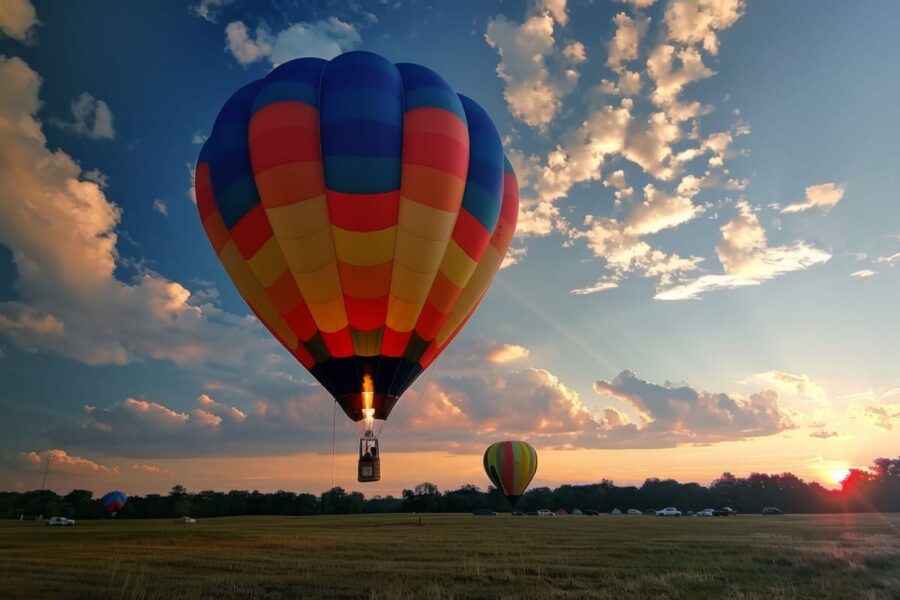
Balloons take off mainly at dawn or before sunset. This is due to atmospheric conditions, because the air is calm and winds are weakest during these hours. Festival organizers should take these limitations into account at the stage of planning the event program.
| Time of day |
Weather conditions |
Flight suitability |
| Dawn (up to 2 hours after sunrise) |
Calm air, light winds |
Best |
| Noon |
Strong thermal turbulence |
Unsuitable |
| Afternoon |
Variable winds, risk of thunderstorms |
Limited |
| Sunset (up to 1 hour before) |
Stabilized air |
Very good |
Cultural events lasting all day can include a balloon flight as part of the evening or morning program. A sunrise flight has an additional aesthetic appeal, though it may require participants to arrive earlier. Evening flights fit perfectly into the atmosphere of summer festivals.
The impact of temperature and air humidity on balloon flight
Air temperature and humidity have a direct impact on the balloon’s lift. Hot and very humid air is less dense, which reduces the temperature difference between the air inside the envelope and the surrounding environment. The consequence is reduced lift and the need for longer heating of the air in the balloon.
On hot summer days, the air temperature inside the envelope must be significantly higher than on cool mornings to achieve the same lifting effect. This affects fuel (propane) consumption and can shorten flight time. The pilot always takes current atmospheric conditions into account when calculating safe payload and planning the route.
Air humidity above 90% is a warning sign for pilots. Such high humidity often precedes precipitation or the formation of fog, which can make flying impossible. Organizers should monitor weather forecasts for at least 48 hours before the planned flight.
Tip: When planning a balloon flight for a summer festival, it is worth consulting with the pilot at least 72 hours before the event. An accurate weather forecast several days in advance allows for an earlier decision regarding a possible change of the flight date.
Balloon flights for cultural events and festivals with ProBallooning
Organizing a balloon flight for a festival requires a partner with an AOC certificate and a proven ground crew. ProBallooning carries out professional hot air balloon flights in accordance with the requirements of the Civil Aviation Authority. Each ascent is conducted by a licensed pilot with experience in both sports and commercial passenger flights.
The company handles events of various scales, from intimate local festivals to large cultural events. Each flight is prepared with consideration for participant safety and efficient ground organization.
Forms of balloon flight for event participants
Festival guests can choose from several flight variants, differing in group size and the nature of the flight.
Balloon flight variants:
Each flight concludes with a traditional aeronaut baptism ceremony and the presentation of a commemorative certificate. Participants are free to take photos throughout the entire flight.
Check Professional passenger hot air balloon flights at ProBallooning
Gift vouchers for hot air balloon flights
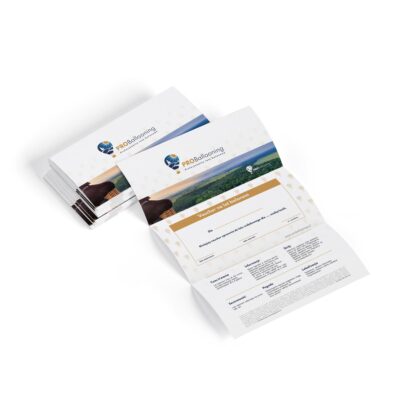
A hot air balloon flight voucher is one of the most popular ways to give a unique gift. ProBallooning prepares them in two variants, tailored to different needs:
- Printed hot air balloon flight vouchers sent by mail in aesthetic packaging, ready to be given as a gift
- Gift vouchers in PDF format available immediately after purchase, perfect for when you need a gift in a hurry
The recipient has 12 months to redeem the flight and chooses the date themselves. Changing the date is free of charge up to 3 days before the scheduled flight.
Authentic reviews from hot air balloon flight participants confirm the high level of service, the professionalism of the pilots, and the efficient organization of every flight.
Check Gift vouchers for balloon flights in PDF at ProBallooning
Tethered balloon flight vs. free flight at a cultural festival
Choosing between a tethered balloon flight and a free flight is one of the first decisions an event organizer must make for a cultural festival. Both types of flights differ significantly in terms of logistics, formal requirements, appeal to participants, and organizational costs. Each has its own application depending on the nature of the festival and the available space.
Comparison of balloon flight types:
- Tethered flight takes place on a mooring line, the balloon does not move away from the launch site, ascents are short (up to 30 meters high), and the number of cycles per day is high
- Free flight has no line, lasts from 60 to 90 minutes, the balloon moves according to the wind direction, landing takes place outside the festival grounds, and it requires a chase crew
A free flight provides passengers with an unforgettable experience, but it is much more difficult to integrate into a festival program. Organization requires more personnel, a vast area, and more precise planning of landing routes. Therefore, most cultural events and festivals opt for tethered flights, which are easier to manage and safer with a large number of participants.
Safety rules for tethered balloon flights for the public
Safety during a tethered flight is based on several strict rules. The safety zone around the balloon must be clearly marked and guarded by personnel. No unauthorized person may approach the balloon during inflation, takeoff, or landing without the pilot’s consent.
Before entering the basket, each participant is informed about the rules of conduct during the flight. The prohibition of holding sharp objects, the requirement to hold onto the handles, and maintaining calm behavior during ascent and landing are the basic rules. Children may participate in the flight only under adult supervision and upon meeting the minimum height requirement, which is usually 110 centimeters.
Safety rules for tethered flight participants:
- Enter the basket only upon the signal of the pilot or ground crew
- Do not lean over the edge of the basket at any time during the flight
- Hold onto the internal handles during ascent and landing
- No open flames or smoking near the balloon
- Immediate compliance with the pilot’s instructions
Adhering to these rules protects both the flight participants and the people gathered on the ground. The pilot has the right to refuse a flight to any person who does not follow instructions or exhibits behavior that poses a safety risk.
Duration and basket capacity of a balloon at an outdoor event
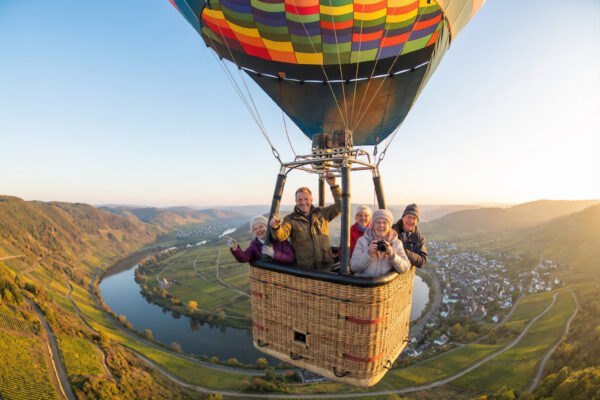
The capacity of a balloon basket depends on its size and is strictly defined by the manufacturer. A standard balloon basket at an event holds from 2 to 6 passengers in addition to the pilot. At festivals with a large number of interested people, larger balloons are used, whose baskets can accommodate even 10 to 12 people at a time. The actual number of passengers also depends on the total weight of all people on board.
The duration of a single tethered flight is typically between 5 and 15 minutes, including boarding and disembarking. For a free flight, the entire journey lasts from 60 to 90 minutes, although the time it takes for participants to return to the event site after landing can double this duration. At festivals, tethered flights are definitely more practical, as they allow for a larger number of participants to be served throughout the day.
Tip: When organizing a flight at a festival, it is worth establishing the maximum daily number of flights with the balloon operator, as well as reserve time for inflating and cooling the balloons between sessions. A schedule that is too tight can lead to overloading the ground crew and causing delays.
FAQ: Frequently Asked Questions
Is a tethered balloon flight during a festival safe for children?
A tethered balloon flight is generally a safe attraction, however, specific age and height restrictions apply. The minimum required height for a participant is usually 110 centimeters. Children under 4 years of age are not permitted to fly, even in the presence of a guardian. For those under 18, the presence of an adult is required for every takeoff.
Before entering the basket, the ground crew informs all participants, including children with their guardians, about the rules of conduct during takeoff and landing. The safety zone around the balloon is clearly marked and guarded, which minimizes the risk of accidental injury. Following the pilot’s instructions is mandatory throughout the entire flight.
How many people can enter the balloon basket at one time during an outdoor event?
The balloon basket capacity depends on its size and the parameters specified by the manufacturer. A standard basket holds from 2 to 8 passengers in addition to the pilot. At larger festivals, balloons with a larger basket capacity are used, capable of holding as many as 10 to 12 people at once. The actual number of passengers always depends on the total weight of all people on board and the weather conditions on the day of the flight.
Event organizers must take the basket capacity into account when planning the schedule. With a smaller basket, the time required to serve all interested parties increases, which requires precise management of the participant queue.
At what time do balloon flights take place during a festival?
Balloon flights at festivals are planned for two time windows during the day. The first takes place right after sunrise, and the second before sunset. The choice of these times is not accidental. In the morning and evening, the air is the calmest, and the wind speed is at its lowest. The middle of the day brings strong thermal turbulence, which makes a safe takeoff impossible.
In the summer months, the launch window is narrower than in the spring or autumn. High temperatures during the day mean that the only safe time for a flight remains early morning or late afternoon. Festival organizers should adapt the event program to these natural limitations.
In case of variable weather, the pilot may decide to delay the takeoff by even several dozen minutes. Flight safety always takes precedence over maintaining the festival’s planned schedule.
What documents must a balloon company have to legally perform passenger flights at an event?
A company performing commercial balloon flights with passengers must hold a valid AOC certificate issued by the Civil Aviation Authority. This certificate confirms compliance with safety requirements, including the technical condition of the equipment, operational procedures, and personnel qualifications. The pilot must hold a valid balloon pilot license and a current aviation medical certificate.
Before each flight, the operator is required to notify the Polish Air Navigation Services Agency of the operation. The notification must be submitted at least 10 days before the planned flight and must include location data, duration, and balloon specifications. Before signing a contract, the event organizer should verify the validity of all the balloon company’s documents in the Civil Aviation Authority’s registry.
Summary
Organizing a balloon flight during a cultural event is a complex undertaking that combines legal requirements, logistics, participant management, and dependence on weather conditions. Every stage, from selecting the site and submitting notifications to the Polish Air Navigation Services Agency, to coordinating the ground crew, requires precision and experience.
The key to success is choosing an experienced balloon operator with an AOC certificate, appropriate insurance, and a proven team. Careful scheduling, clear communication with participants, and a flexible approach to weather changes make a balloon flight at a festival one of the most memorable attractions of any outdoor event.
Sources:
- https://www.gov.pl/web/psse-pisz/informacja-dla-organizatorow-imprez-masowych
- https://pl.wikipedia.org/wiki/Balon
- https://www.ulc.gov.pl/pl/regulacje-prawne/prawo-polskie/prawo-lotnicze
- https://en.wikipedia.org/wiki/Hot_air_balloon
- https://en.wikipedia.org/wiki/Air_operator%27s_certificate
- https://www.pansa.pl/
- https://en.wikipedia.org/wiki/Hot_air_ballooning